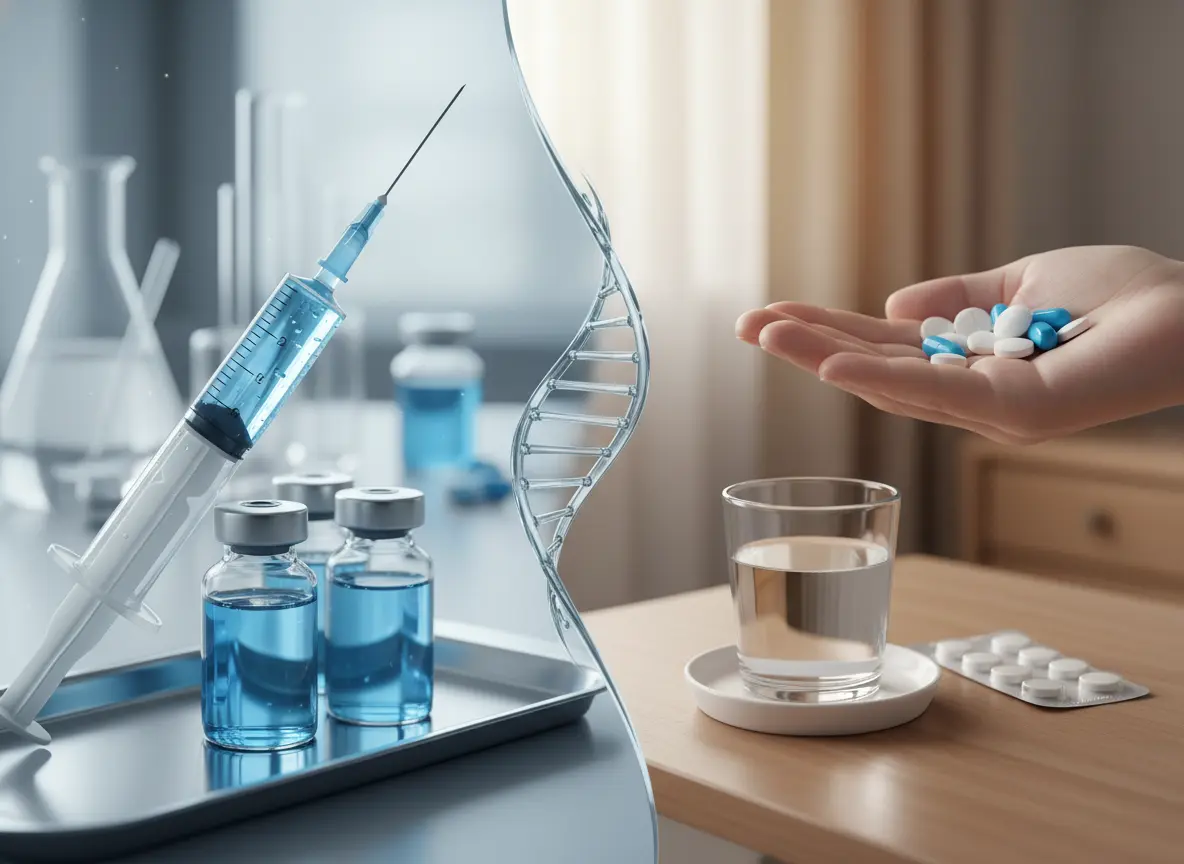
BPC 157 Capsules vs Shots: Key Differences
Table of Contents
In the world of peptides, BPC 157 is a synthetic peptide that has been studied for its potential role in supporting certain biological processes related to tissue and digestive health. As more people explore peptide therapy, one common question arises: should you take BPC 157 orally in capsule form or by injection? Understanding the differences between these delivery methods can help you make an informed decision.
Quick Answer
BPC-157 Capsules vs Injections: What’s the Difference?
BPC-157 capsules are easier to take and are often discussed for digestive-related support. Injections bypass digestion and may allow for greater systemic exposure, making them the more common route for localized tissue and recovery goals. Neither form is FDA approved. The right delivery method depends on your symptoms, health history, treatment goals, and provider guidance — not personal preference alone.
Many patients choose to make this decision with clinical guidance through our Primary Concierge program, which offers medically supervised peptide therapy and personalized recommendations.
BPC-157 Capsules vs Injections: Side-by-Side Comparison
| Factor | Capsules (Oral) | Injections (Subcutaneous / IM) |
|---|---|---|
| Administration | Swallowed by mouth | Injected under skin or into muscle |
| Absorption | Lower — digestion reduces bioavailability | Higher — bypasses digestive system |
| Needle required | No | Yes |
| Common discussion areas | Digestive support, convenience | Localized tissue support, recovery goals |
| Onset | Slower | More direct |
| Travel / daily use | Easier | Requires supplies and storage |
| Provider monitoring | Required | Required |
| FDA approval status | Not approved | Not approved |
Absorption, Convenience, and Provider Guidance: What Actually Matters
When patients compare BPC-157 capsules and injections, two things usually come up first: how well it absorbs, and how easy it is to take. Both matter — but neither should drive the decision on its own.
Absorption: Why Delivery Method Affects Results
BPC-157 is a peptide, which means it is a chain of amino acids. When taken orally, it travels through the digestive tract before reaching circulation. Digestive enzymes and stomach acid can break down peptides before they are fully absorbed, which reduces the amount that reaches target tissues.
Injectable BPC-157 bypasses digestion entirely. Subcutaneous and intramuscular delivery allow more of the peptide to enter circulation directly, which is why injection is the more commonly discussed route for recovery and tissue-related goals.
That said, some preclinical research has explored oral BPC-157 in the context of gastrointestinal health, where localized gut exposure may be relevant. Human clinical data remains limited for both forms.
Convenience: Capsules Are Easier, But Easier Is Not Always Better
Capsules are simpler. No needles, no preparation, no refrigeration in most cases. For patients with needle aversion or who travel frequently, oral BPC-157 may feel more manageable day to day.
Injections require more setup: sterile supplies, proper injection technique, and site rotation to avoid irritation. When administered or supervised by a provider, this is straightforward. Self-injection without clinical training introduces unnecessary risk.
What Your Provider Needs to Evaluate Before Recommending Either Form
A licensed provider should review your treatment goal, health history, current medications, and comfort level with each method before recommending a delivery route. Factors that influence the recommendation include:
- Whether your primary goal is digestive support or systemic recovery
- Your history with injections or needle-related anxiety
- Any gastrointestinal conditions that could affect oral absorption
- Current medications that may interact with peptide therapy
- Whether BPC-157 is appropriate for your situation at all
Patients exploring peptide therapy as part of a broader recovery plan may also want to review Regenerative Medicine at Tucson Wellness MD to understand how these therapies fit into a full treatment approach.
Choosing the Right BPC-157 Form Based on Your Health Goals
There is no universal answer. The better delivery method depends on what you are trying to accomplish and what your provider determines is appropriate for your situation.
If Your Goal Is Digestive or Gut-Related Support
Oral BPC-157 is often the form discussed in the context of gastrointestinal health. Because capsules deliver the peptide directly into the digestive tract, some providers consider this route when the primary concern involves gut-related symptoms. Evidence in humans remains early and limited. A provider should assess whether this is appropriate before starting.
If Your Goal Is Recovery, Injury Support, or Tissue Repair
Injections are more commonly discussed for these goals. Direct delivery into circulation allows the peptide to reach target tissues without the absorption loss associated with oral forms. Patients focused on training recovery, joint support, or injury-related goals are more often evaluated for injectable protocols.
Patients pursuing performance and recovery support may also benefit from reviewing Peptide Therapy at Tucson Wellness MD and the broader Strength and Performance program.
If Convenience Is the Primary Factor
Capsules offer a simpler daily routine and are easier to manage during travel or busy schedules. If absorption trade-offs are acceptable given your goals and your provider agrees, oral BPC-157 may be reviewed as part of your plan.
If You Are Unsure
Start with a provider evaluation. A clinical consultation at Tucson Wellness MD can help you review whether BPC-157 is appropriate, which form fits your goals, what dosing may look like, and what monitoring would be involved. Reviewing our BPC-157 dosage guide beforehand gives you useful context going into that conversation.
What Is BPC-157 and Why Is It Used?
BPC 157, also known as Body Protection Compound 157, is a synthetic peptide derived from a natural protein found in gastric juices. Preclinical research has explored its interaction with cellular signaling pathways involved in vascular and inflammatory responses. However, clinical data in humans remains limited. Some individuals explore BPC 157 under medical supervision as part of a broader wellness or recovery plan. Individual response may vary.
Can BPC-157 Be Taken Orally?
Yes. BPC 157 is available in capsule form.
Oral BPC 157 passes through digestion before entering circulation, which may reduce absorption compared to injections. Injectable delivery bypasses digestion and provides more direct systemic exposure.
Oral forms are sometimes discussed for digestive support, but human clinical evidence remains limited.
Because BPC 157 is not FDA approved, use should only occur under licensed medical supervision. For a deeper dosage breakdown, review our BPC-157 dosage guide before comparing delivery options.
BPC-157 Capsules: Benefits, Absorption, and Daily Use

Oral BPC 157 is typically available in capsule form. This method is convenient and easy to use, making it appealing for those who prefer to avoid needles. However, the main concern with oral delivery is bioavailability, or how much of the peptide is absorbed into the bloodstream after digestion.
Benefits of BPC 157 Capsules
- Easy to take with no injection required
- Convenient for travel or daily use
- Oral formulations are sometimes discussed in relation to digestive applications, though research is ongoing and evidence in humans is limited.
What to Consider With Oral BPC 157
- Reduced absorption compared to injections
- Effectiveness may vary from person to person
- Slower results when targeting muscle or tendon repair
BPC-157 Injections: Absorption, Delivery, and Use Cases
Injectable BPC 157 is delivered either subcutaneously (under the skin) or intramuscularly (into the muscle). This method bypasses the digestive system, which means more of the peptide reaches the bloodstream and target tissues.
Key Benefits of BPC 157 Injections
- Injectable delivery bypasses digestion and may allow for greater systemic exposure compared to oral forms.
- Some clinicians consider this route when targeting localized tissue concerns.
- Clinical evidence remains limited and outcomes vary by patient.
What to Consider With BPC 157 Shots
- Requires comfort with self-injection or professional administration
- Mild side effects such as redness or irritation at the injection site
- Less convenient for people who dislike needles
BPC-157 Capsules vs Shots: Which Is Better for Your Goals?
When comparing oral capsules and injections, the right choice depends on your goals. If your main focus is gut health, oral BPC 157 may offer benefits directly in the digestive system. Choice of delivery method depends on individual goals, clinical judgment, and tolerance for administration methods. No form is universally superior, and clinical data is still evolving. Patients focused on training recovery may also review strength and performance support.
Which BPC-157 Option Fits Your Recovery Goal?
There is no one-size-fits-all answer.
Capsules may fit patients who want convenience or who are discussing digestive-related support with a provider. Shots may be reviewed when a patient wants more direct delivery or when the treatment goal involves localized recovery.
The better choice depends on your symptoms, health history, medications, comfort with administration, and provider recommendation. BPC-157 is not FDA approved for general medical use, so patients should avoid self-sourcing or guessing their own protocol.
BPC-157 Side Effects and Safety Considerations
BPC 157 is not FDA-approved for medical use. Safety data in humans is limited, and therapy should only be considered under licensed medical supervision though research is still ongoing. Some users report mild side effects, including:
- Temporary redness at the injection site
- Slight fatigue
- Digestive discomfort with capsules
These effects are usually minimal compared to other performance-enhancing compounds.
Safety Note Before Choosing Capsules or Shots
BPC-157 should not be treated like a basic supplement. Product quality, delivery method, dosage, cycle length, and medical history all affect safety. Speak with a licensed provider before starting, switching, or combining peptide protocols.
How to Choose the Right Form of BPC 157
Both capsules and injections of BPC 157 can support healing and wellness, but each method has unique strengths. Capsules offer convenience and may help with digestive health, while injections provide higher absorption and faster results for injuries.
Who Should Compare BPC-157 Capsules and Shots?
This comparison helps people who want to understand the difference between oral and injectable peptide therapy before speaking with a provider. Capsules may appeal to patients who want convenience, while injections are often discussed for more direct delivery. A provider should help determine which option fits your goals and safety needs.
Explore Medically Guided Peptide Therapy
If you are considering peptide therapy, working with a trusted medical provider is the safest way to achieve results. At Tucson Wellness MD, we specialize in customized peptide treatments, including BPC 157, designed to support healing, recovery, and overall health.
Learn more about provider-guided peptide therapy at Tucson Wellness MD.
Why Medical Guidance Matters Before Choosing Capsules or Shots
BPC-157 capsules and shots should not be treated like standard supplements. Your delivery method, dosage, cycle length, and monitoring needs depend on your health history, current medications, symptoms, and treatment goals. A licensed provider can review whether BPC-157 is appropriate and help determine which option fits your treatment plan safely.
Not Sure Which BPC-157 Form Is Right for You?
Tucson Wellness MD offers medically supervised peptide therapy consultations. We review your symptoms, health history, recovery goals, and treatment options before recommending any protocol — including whether BPC-157 capsules or injections are appropriate for your situation.
Schedule a Peptide Therapy ConsultationFrequently Asked Questions About BPC-157 Capsules vs Shots
Are BPC-157 capsules effective?
BPC-157 capsules are often discussed for convenience and digestive support, but effectiveness depends on the treatment goal, product quality, absorption, and provider guidance. Capsules may not be the best fit for every patient. A licensed provider can help determine whether oral BPC-157 makes sense for your situation.
Does BPC-157 work better as a capsule or shot?
Neither form is automatically better for every patient. Capsules are often discussed for convenience or digestive-related goals, while shots are often reviewed for more direct delivery. The right option depends on the patient’s symptoms, goals, safety needs, and provider recommendation.
Which BPC-157 form is better for recovery?
The better form depends on the type of recovery goal. Injections are often discussed for more targeted tissue support, while capsules may be reviewed for convenience or digestive-related concerns. A provider should help match the delivery method with your symptoms, goals, and health history.
Are BPC-157 capsules safer than injections?
Capsules may feel easier because they do not require injections, but safety still depends on product quality, dose, health history, medications, and medical supervision. A provider should review whether either form is appropriate.
Can I switch from BPC-157 capsules to shots?
Do not switch delivery methods without provider guidance. Capsules and shots may involve different dosing, absorption, monitoring needs, and safety considerations.
Who should avoid BPC-157 capsules or shots?
Patients who are pregnant, breastfeeding, managing a chronic medical condition, taking multiple medications, recovering from surgery, or dealing with unexplained pain should speak with a provider before using BPC-157.
Is BPC-157 FDA approved?
BPC-157 is not FDA approved for general medical use. Patients should avoid self-sourcing or using it without clinical guidance. A licensed provider can explain the risks, alternatives, and whether peptide therapy is appropriate.